Back in Buenos Aires
After the Plague Year


Buenos Aires, March 2022
Queridos amigos,
At the end of the first plague year, in the autumn of 2020, we left Argentina. We had come for two months. Caught up in the coronavirus quarantine, we had stayed almost a year.
Briefly, the airports opened. We bought our tickets home.
We had been living on our farm in the Precordillera of the Andes, cut off from the rest of the country by mountains and rough roads. Two of the fincas lie on either side of the Calchaquí river, in rich, sandy bottomland. The other three, on the other side of low mountains, are set on a high desert plain and in tightly-cultivated quebradas watered by three small rivers.
For nine and a half months, we lived the life of the vallista. We ate asados and sopas; spoke, in our fashion, castellano; traveled on horseback and in a pick-up; paid homage to los santos patronales in misas chicas and the farm’s capillas. We faced rebellious originarios and overweening neighbors, and reckoned with age-old water rights, a barter economy, and family feuds. We grappled with the harsh vagaries of raising livestock and crops in this arid country.
It was a beautiful, inspiring, exacting experience. And we wore holes in our thin-soled shoes and city jeans. It was time to go home.
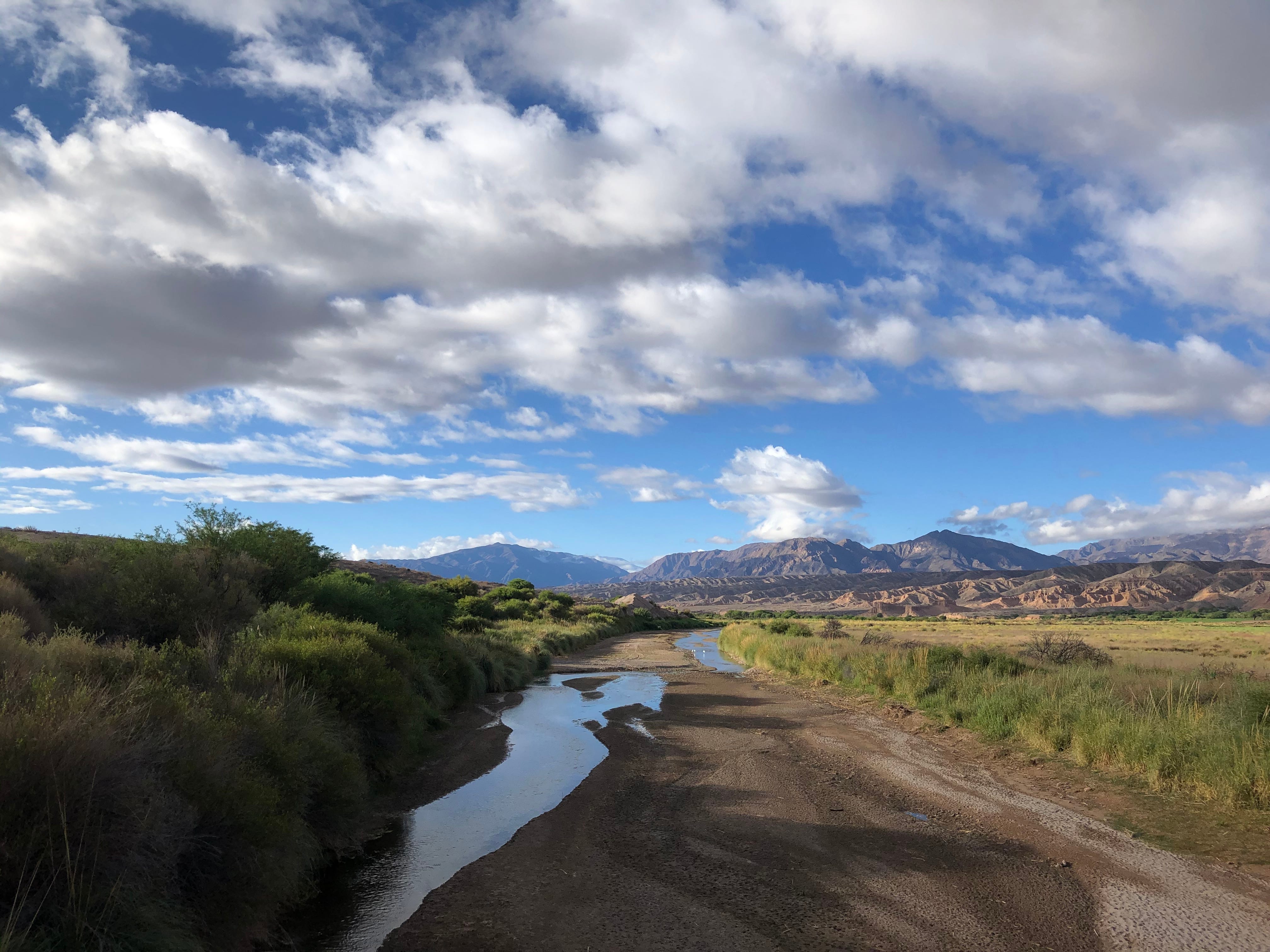
Last view of Fincas San Martín and La Arcadia, on either side of the río Calchaquí. Beyond the mountains lie Gualfín, Pucarilla, and Compuel.
We drove one last time down from the mountains to the provincial airport of Salta Ciudad. We boarded a plane for the capital city.
In Buenos Aires then, it was late spring. The leaves of the plane trees overhanging the streets were already lush and green, but without a trace of summer dust. The air was still fresh and cool. The city was quiet.
Our administrador had found us a hotel, one of the few still open. The Mansion Algodon had been built as a private petit hôtel in the French manner in 1912. Tall windows opened onto the quiet calle Montevideo. Our room overlooked a shady green garden.
We were the only guests in the hotel. Like happy ghosts in a strangely familiar, half-empty world, we went outside exploring. The novelty of the city was enchanting. We sat under the trees at an improvised sidewalk lounge. We had medialunas and cappuccinos. On the side of the cup floated a big-eared teddy bear sculped in foam. I bought a medallion in a tiny jewelry shop, just for the pleasure of shopping, though I couldn’t stop myself from bartering. We had dinner in a restaurant. The next day, we took a taxi to the international airport and flew home. And Argentina closed its borders again.
Our brief time in Buenos Aires had been a bridge, preparing us to enter our old familiar world. Now, almost two years later, it was our threshold back to the valleys and mountains of the Calchaquí. We spent a few days getting to know the city again before heading north.
Buenos Aires, like Argentina itself and our own selves, is tentatively emerging from two years of enforced inactivity.
The hotel was reassuring just the same, although the manager had taken off the outer door-knob. This, he explained, hurrying to grasp the inner knob and the edge of the door to open it, was to deter robbers. A few blocks away, the street was blocked off with bollards while an armored van transferred money to a bank. Armed guards in bullet proof vests stand casually outside restaurants and shops, part of the ordinary landscape. Over 20 years, Argentines have been impoverished by inflation. Stacks of pesos and $100-dollar bills pay for everything from a necklace to a new tractor. All that cash is tempting.
Meanwhile, the improvised café had disappeared. So had the jeweler. But on a crescent-shaped plazoleta nearby, we had cafecitos and medialunas under an umbrella. Slowly, the neighborhood came awake.
In the bright mid-morning sunlight, a young man and woman made up crates of vegetables and fruit from their battered panel-truck parked in the street. They ferried them to the restaurant, and around the corner to apartment dwellers and a grocer. An aproned maid walked a little dog. Small children dressed in school uniforms pattered along on the sidewalk, accompanied by their mothers. Men with black backpacks, couriers of cash, strode along briskly, heads discreetly lowered. Elderly ladies and men sat down to converse with friends or read the paper. Someone was doing email on a laptop. It was Friday morning in Recoleta, the barrio where some of the lost wealth of Argentina’s golden heyday still quietly compounds.
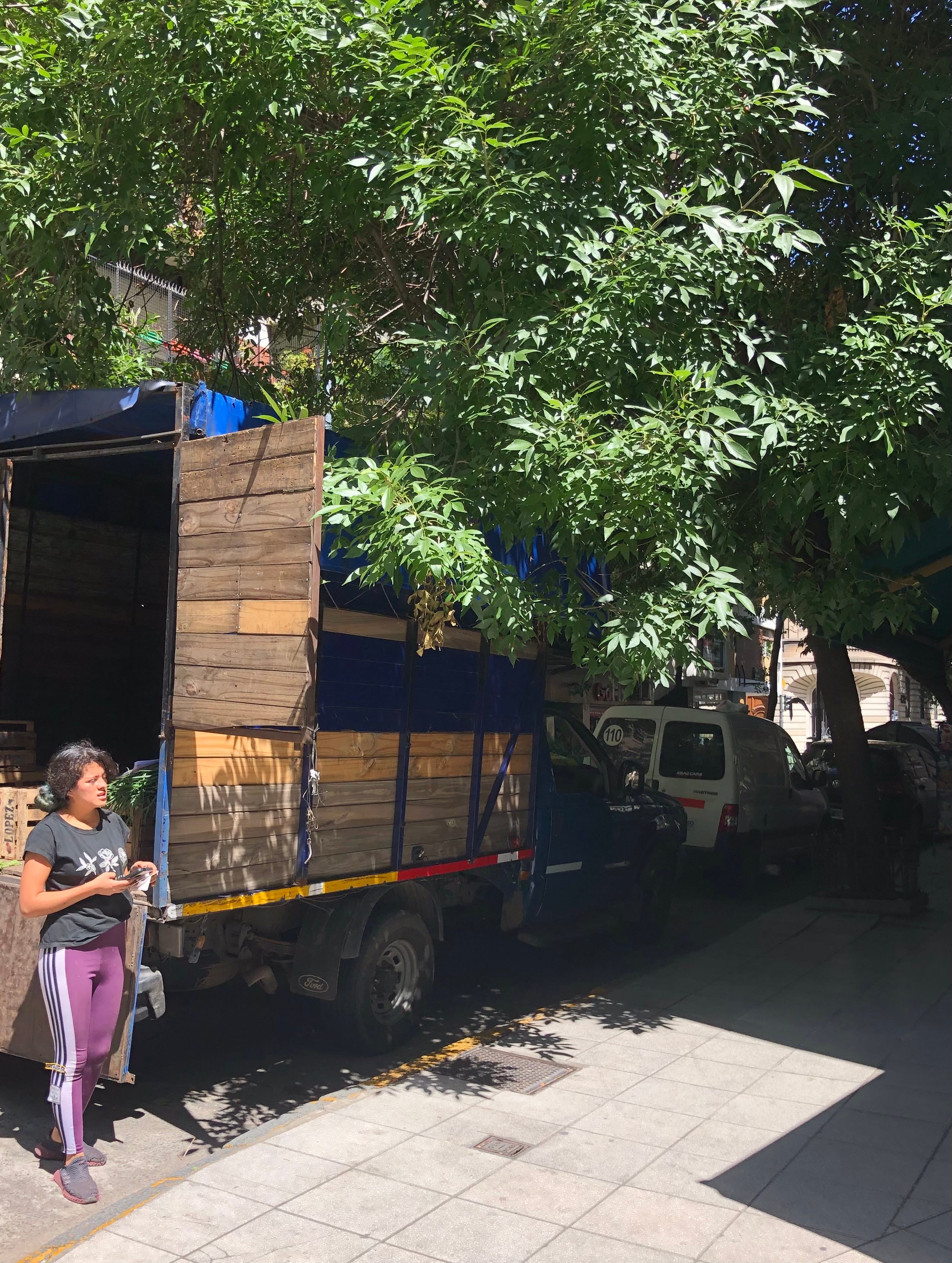
A young woman takes orders beside her vegetable truck in the fashionable barrio of Recoleta.
Cash is king in Argentina. Our next stop was “la Cueva.” This is a dingy storefront in a shabby arcade of shops, most of them closed. There is no sign, just a dollar bill taped to the frosted glass. The tattooed money-changer, no ilk to the elegantly-clothed residents of Recoleta, wore thick dreadlocks, three of them standing up like feathers at the back of his head. He discounted our 500-euro notes; smaller notes were easier to move, he explained with matter-of-fact calm.
With our thick wads of cash, we went to dinner that night at “Fervor,” a new restaurant in the neighborhood named after the poet Borges’ elegy to Buenos Aires.
Borges wrote a little poem to the city, which ends:
No nos une el amor sino el espanto;
será por eso que la quiero tanto.
Love does not unite us, but terror;
Thus it is that I love her so.
Only once did we venture beyond our comfortable surroundings around Montevideo Street. Late on a Sunday afternoon, we visited the Museo de Bellas Artes.
Through Recoleta’s park, we strolled under the vast canopy of the gomera trees with their huge knobby trunks and spreading roots. We passed the statue of Santiago de Liniers. Liniers, a naval officer, twice rescued Buenos Aires from British invaders and was appointed viceroy of Rio de la Plata. After taking part in a royalist uprising against the revolutionaries of May 1810, he was shot.
We passed the 18th-century church of the Recoleto friars, a reformed branch of the original Franciscan order which had accompanied Mendoza on the Conquista. In the friar’s orchard, now a cemetery, Evita Perón is buried.
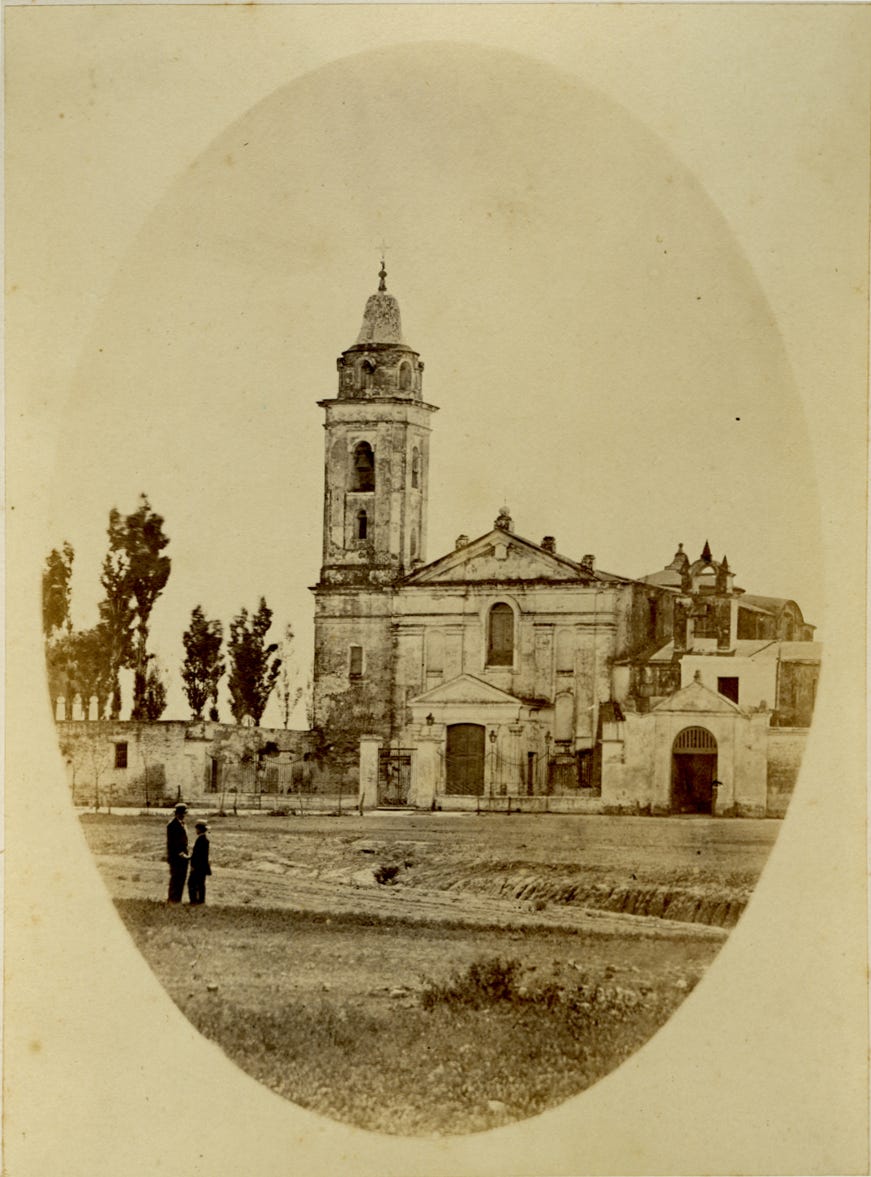
Nuestra Señora del Pilar, built for the Recoleto friars in 1732, photographed in 1864. Beside it, Buenos Aires' first public cemetery, constructed after the Franciscans were expelled from Argentina in 1821.
A mercado de artesania was folding down for the weekend; languid passersby glanced idly at wooden incense holders and striped Bolivian vests. We crossed the wide, blank avenue of the Libertador, named for Simón Bolivar, the aristocrat, liberale, and general who led the emancipation of South America from Spain in the early 1800s. In a letter written shortly before he died in 1830, Bolivar reflected sadly that:
“El que sirve una revolución ara en el mar…
He who serves a revolution plows the sea.”
“Fellow citizens!” he stated, addressing the legislators of the new nation of Colombia, “I blush to say this: Independence is the only benefit we have acquired, to the detriment of all the rest.”
Rather than a new South American federation united by common ideals of liberty, brotherhood, and progress, the new order fell prey to war, civil war, dictatorship, and economic collapse.
Crossing the avenue, we merged into a scattered crowd enjoying the end of a sunny weekend. There were short, stocky provincials on an outing in the city; kids on skateboards; animé-inspired teenagers in black; a group of women dressed up for an evening on the town.
Not far, the Museo is housed in the disaffected Casa de Bombas. This was the pumping station for Buenos Aires’ first public system of running water, the first such system in the Southern Hemisphere. Undertaken to avoid successive waves of deadly yellow fever, it was designed to serve a city of 150,000. By the time it started pumping purified water to households in 1870, the system was already undersized. Fifteen years later, immigration had swelled the population four-fold. The Museo moved here in 1933.
“Adelante, adelante en todo. Ya verá la Republica y tambien los demás naciones del continente! La nuestra será para ellas lo que Grecia en el mundo antigua!,” declaimed Eduardo Wilde, minister of the Interior in the 1880s.
“Forward, forward in everything. Thus will be seen the Republic of Argentina and the other nations of the continent! Our nation will be for our sister nations as Greece to the ancient world!”
This marvelous country, beacon to the continent, had been founded on Enlightenment ideals and built on the fabulous fertility of Argentina’s pampas farmland. First among nations in wealth, technology, and public hygiene, it must also lead, like Ancient Greece, in culture. The Museo de Bellas Artes opened its doors in 1895.
Patrons plucked Old Masters from the walls of their petits hôtels. Collectors returned from annual sojourns in Paris with fashionable Impressionists and later with Cubists and Surrealists, and works by Picasso, Modigliani, Kandinksy. The museum developed a substantial collection of modernist Argentine artists.
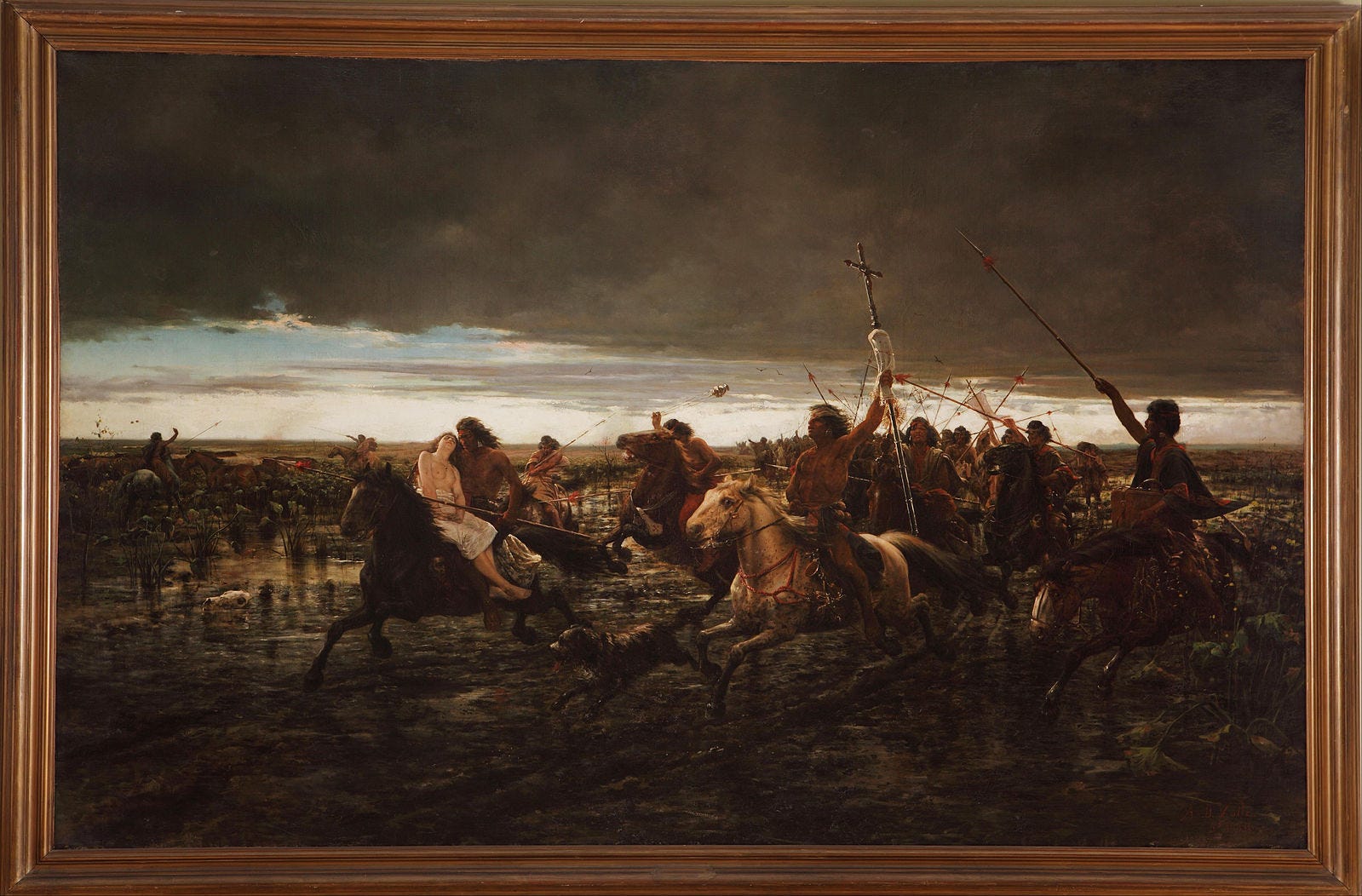
“La vuelta del malón,” Angel Della Valle, 1892, Museo des Bellas Artes
Like our walk through the park, the Museo is a narrative. Not just about the objects in the collection, but what they represent over time. In the gallery of Argentine history painting, we stopped for a moment in front of Angel Della Valle’s “La veulta del malón,” “The Return of the Raid,” of 1892. It was painted for the Chicago Columbian Exhibition, held on the four hundredth anniversary of Columbus’ landing in the Americas. For generations, as the “primera obra de arte genuinamente nacional,” it was heralded as a fine example of a native-born artist turning his brush to the national epic.
In the foreground, a Mapuche horseman holds aloft a processional cross. Another swings an incense-burner. And another carries off a woman, her golden hair swirling over her half-naked body. Painted a decade after the last battle in the Conquista del Desierto, here is an explanation of why the young Argentine Republic sent an army against the Mapuche. Of course, the Desert Campaign was not only fought to protect the sacred and the settler. General Roca, his officers and soldiers divided up the vast and now secure pampas into fertile farms.
Meanwhile, up on the third floor, a photograph of Che Guevara was part of a multi-media exhibit, “El día que me quieres,” by a contemporary artist, The title of a famous Argentine tango, it means “the day you love me.”
In Korda’s famous photograph, the heroic guerilla gazes resolutely forward. But here, the revolutionary lay dead, shirtless. His eyes, framed by long curling lashes, are half-open, focused on a distant view. His slightly parted lips reveal even, white teeth. He could have been anyone’s handsome son or boyfriend, or just a corpse on a dissection table. He had been shot, executed by the Bolivian army, victim of the summary justice he himself had pitilessly practiced on hundreds of others.
Libre de la memoria y de la esperanza,
ilimitado, abstracto, casi futuro,
el muerto no es un muerto: es la muerte
Free of memory and of hope
Unlimited, abstract, almost of the future,
The dead one is not a cadaver: he is Death”
wrote Jorge Luis Borges, in “Remordimiento por cualquier muerte,” “Lamentation for any corpse,” written at the death of his mother.
Che, like Bolivar, Liniers, Evita, the Malpuche and even the Conquista’s Franciscan friars, crossed out of life and into Argentina’s national epic. Killer and victim, Che Guevara chased the enemies of revolution through the Andean mountains and the African jungle until he himself was at bay. Did Che wonder at the last if he, too, was plowing the sea?
A buzzer sounded. It was time to go. The guards, like officious cultural police, had been continually urging the public to pull up their masks and keep a distance from the paintings. Now they hustled us out of the museum.
Elizabeth
(*****) Five stars, dear Elizabeth: extraordinary writing, introducing me to the history of a country becoming more lovable with every one of your sentences. Thank you, thank you, thank you! My beloved B'Aires-born grandmother Elizabeth "Lily" Lahusen would have loved your writings, and maybe have learned a thing or two as well! She lived to the ripe old age of 96 and made fun of her prominent "Jewish" nose in one of our private conversations. Her mother was from the German Jewish Leinau merchant family. Big hug to you, dear Lady! A wonderful Christmas present for this incorrigible German romantic.....